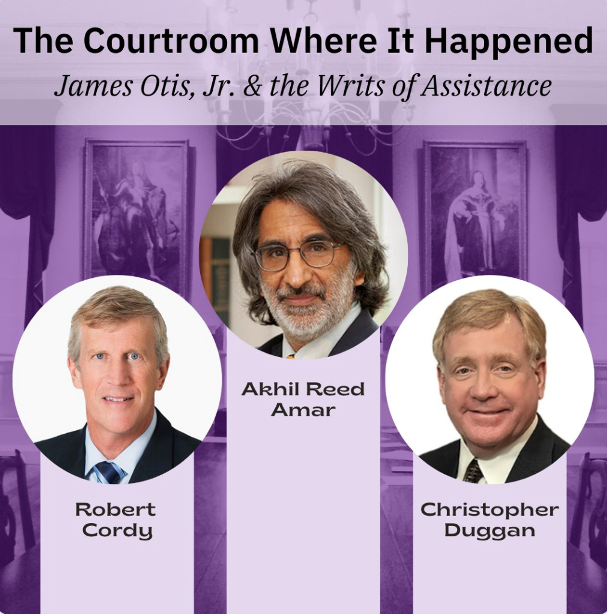
In 1761, attorney James Otis, Jr. delivered a passionate defense in the Writs of Assistance case, laying the groundwork for fundamental democratic principles that continue to shape our lives today.
Many trace the spark that lit the American Revolution to a courtroom in 1761, when Otis transformed his arguments in a search-and-seizure case into a fiery and wide-ranging five-hour oration that laid down many concepts foundational to our democracy.
Otis’s 18th-century arguments continue to shape various aspects of our 21st-century lives, including topics like taxation without representation and rights against search and seizure.
A June 17th program reflected on Otis’s passionate defense in the Writs of Assistance case, laying the groundwork for fundamental democratic principles that continue to shape our lives today. The program also focused on the vital role that lawyers play in sustaining the rule of law that underpins healthy democracies.
Insightful commentary from several legal luminaries delved into the legal, political, and personal drama surrounding this landmark case.
Christopher Duggan, one of the most accomplished trial and appellate lawyers in the United States and the leading force behind the James Otis Lecture Series of the Massachusetts Chapter of The American Board of Trial Advocates participated.
Other panelists included Akhil Reed Amar, the Sterling Professor of Law and Political Science at Yale University, where he teaches constitutional law at both Yale College and Yale Law School, and former Associate Supreme Judicial Court Justice Robert Cordy, who has worked with judges around the world on issues relating to judicial ethics, rule of law principles, and the American judicial system.
For the event at the Old State House Meeting House, the Council Chamber was set up as it would have been when Otis originally argued the original Writs of Assistance case. This free program was made possible by the generous support of The Lowell Institute.